


A short-path distillation head is a compact distillation column designed to separate molecular vapor streams through controlled phase changes. It minimizes the distance vapor must travel before condensation, allowing compounds to be efficiently fractionated into multiple purified liquid or solid streams. By reducing vapor travel distance and exposure time at elevated temperatures, short-path distillation maximizes yield while helping prevent thermal degradation of heat-sensitive compounds.
Key Features and Design Components
- Integrated Design: The head assembly extends from the input port to the temperature port, with a strategically engineered internal pathway between them designed to achieve specific separation results. Variations in geometry, staging, and overall design influence performance and are tailored to different processing methods, operational practices, and starting materials.
- Condenser Coil: Features internal cold surfaces with dedicated hose nozzles for circulating chilled cooling fluid.
- Vacuum: Vapor is drawn through the discharge port of the distillation head under continuous vacuum. As the vapor travels toward the pumps, it passes through a series of pathways designed to dramatically cool and condense it. The vacuum remains actively engaged throughout the distillation process, ensuring efficient vapor movement and separation.
- Design: Constructed from high-quality, heat-resistant borosilicate glass, these distillation heads are designed to withstand elevated temperatures and rapid thermal changes. The internal geometry—including pathway shape, flow design, and head configuration—plays a critical role in performance, making head selection an important consideration for producers seeking optimal efficiency and application-specific functionality.
How does it work?
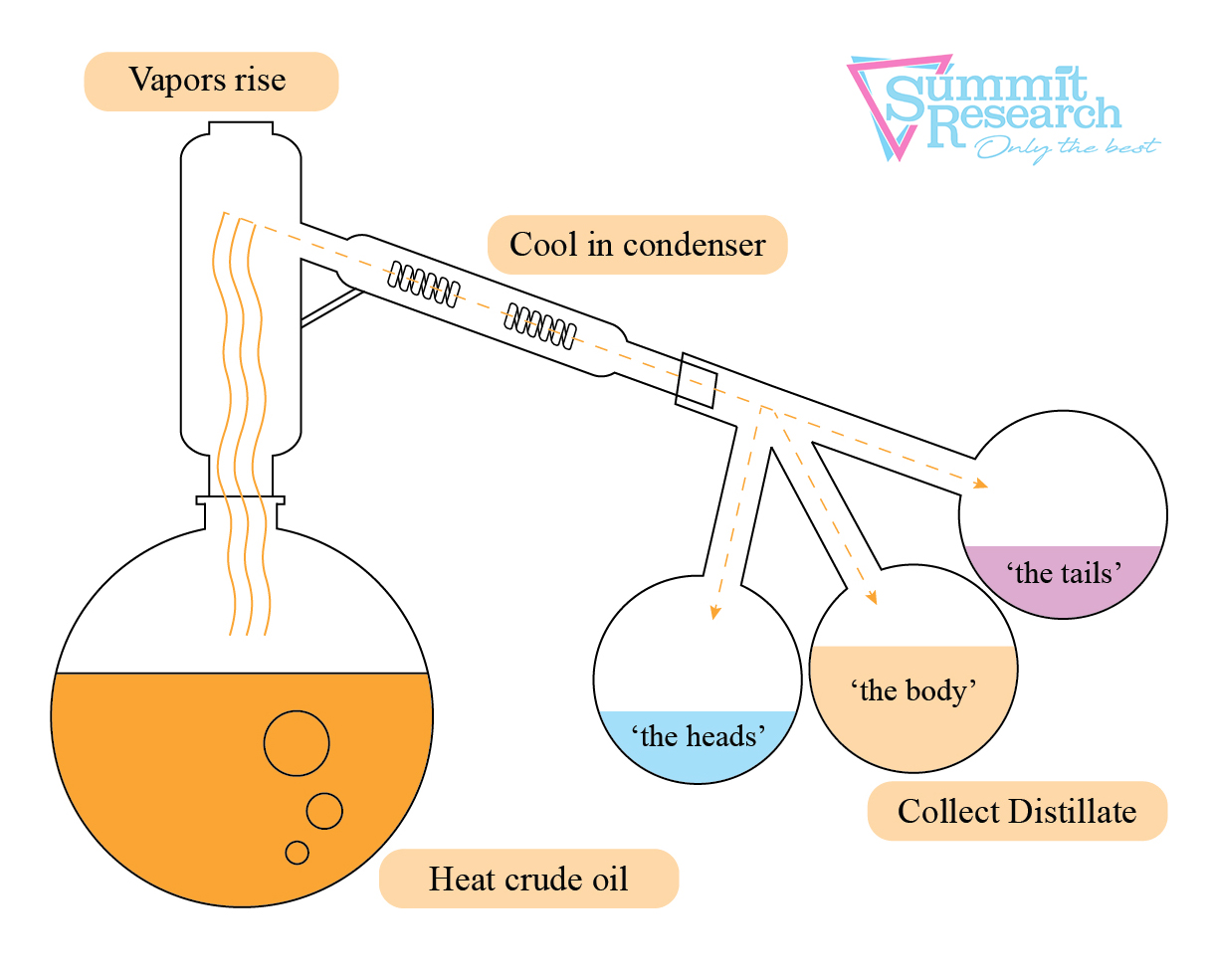
Once the vapor is condensed, it drips down the condenser arm, allowing individual compounds to be selectively separated based on their boiling characteristics.
Under vacuum, the distillation process transforms a product matrix or previously fractionated material from a liquid or solid phase into a vapor phase, allowing individual compounds to be selectively separated based on their boiling characteristics. As the vapor condenses back into liquid or solid form, the molecules are collected in distinct fractions, enabling efficient purification while helping preserve heat-sensitive compounds from degradation. Understanding the operation of a short path distillation head requires breaking down the process into 6 sequential steps:
- Heating the Mixture: Distillation can be performed at virtually any temperature, depending on the boiling characteristics of the target compounds. In most distillation processes, compounds separate and collect in stages, or “fractions,” as different molecular groups vaporize within specific temperature ranges. By adjusting temperature parameters forward or backward, operators can target approximate molecular windows for collection—a principle common to wiped film and many other distillation methods. Short-path distillation, however, is often engineered for tighter fractionation and higher-purity purification, allowing for more precise separation compared to some commercial or wiped-film systems that operate with broader, more liberal collection ranges.
- Vacuum Pressure Reduction: A vacuum pump is connected to the distillation system to significantly reduce the internal atmospheric pressure. Lowering the pressure decreases the boiling points of the materials being processed, allowing compounds to vaporize and distill at more manageable temperatures. Operating under vacuum conditions helps minimize thermal stress, reduce the risk of oxidation or surface ignition, and protect sensitive molecules from degradation that can occur at higher temperatures under normal atmospheric pressure.
- Vapor Travel & Fraction collection: Typical distillation heads without patented fraction collector technology recover only a minimal amount of condensate near the exit port. Summit’s evolved fraction collector design improves efficiency by utilizing advanced internal geometries that enhance condensate management, resulting in greater clarity and higher levels of purification within the collection zone. The upper section of the head contributes additional condensation effects, working in conjunction with the condensing arm to regulate and supply a consistent condensate flow, ultimately supporting a more stable and efficient product exit stream.
- Purification Through Design: Our family of fraction collector heads—from the legacy FC34 design to the patented SPD-8 coiled head platform—incorporates a range of technologies engineered to control and optimize the distillation process. Each head is designed with different operational characteristics: some provide greater rejection and tighter fractionation, while others allow broader collection ranges with minimal rejection. Certain designs are optimized for low-temperature, high-speed refinement, whereas others are built for extremely high-throughput processing with less precision-focused separation. Because every starting material behaves differently—from heavily contaminated crude inputs to highly refined chromatography-grade material—there is a purpose-built head configuration suited for each application, allowing operators to achieve the best possible balance of speed, purity, and efficiency.
- Temperature Monitoring: There are generally two modes of operation in short-path distillation: monitored testing and experience-based refinement. During initial process development or testing, operators often use temperature monitoring to observe vapor behavior and identify boiling point transitions within the system. This is typically done with a small temperature probe or thermowell positioned near the vapor pathway to track reaction and vapor temperatures in real time. More experienced users, however, may rely on distillation keys or stopper configurations tailored to known process conditions, allowing them to refine separations without continuously monitoring vapor temperature points.
- Fraction Collection: The end port collects fractions corresponding to distinct “temperature zones,” allowing compounds to be separated based on their boiling ranges. In practice, a user can heat a mixture to progressively distill components from lower to higher temperatures, beginning with low-boiling fractions, followed by the desired main body fraction collected within a target temperature window, and finally higher-boiling tail fractions. Each fraction is isolated as it exits the system, enabling selective retention or removal. The main body is typically retained as the primary product, while the initial and tail fractions can either be set aside for further refinement or discarded, depending on the process requirements.
In summary, a short path distillation head is an essential component for achieving efficient, high purity separations in laboratory distillation processes. By combining Technologies with borosilicate glassware, it allows operators to process heat-sensitive compounds with minimal degradation and maximum purity available for each process/fraction. Whether used in research laboratories, chemical processing, or advanced extraction workflows, short path distillation remains one of the most reliable methods for controlled, high efficiency purification.